The AI operating system for agribusiness
A production AI layer for agriculture, built to be acquired and dropped into your stack, your data, and your brand.
Live in production today
90+
Alora agent tools, read and write
1,000+
Agronomic rules, evaluated daily
28
Geospatial execution types
19
Interface languages
Mobile, Web, API
Shipping channels
What an acquirer gets on day one
Not a concept deck. Xsupra transfers as a working AI farm operating system: agent, execution engine, rules, data adapters, mobile, web, and admin.
Acquisition thesis
- Add AI advisory to an existing agronomy or machinery portfolio without starting a multi-year build.
- Turn proprietary field, product, and grower data into maps, documents, tasks, and daily recommendations.
- Keep the buyer's core systems in place. Xsupra maps to them through external IDs, APIs, service roles, and standard geospatial formats.
- Own the control plane for autonomous machinery, drones, and robotics over time, grounded in the execution pipeline that already creates field actions.
Integration model
Keep existing systems. Insert the Xsupra intelligence layer where decisions and actions are created.
Buyer systems and data
CRM, farm-management platform, product catalog, field boundaries, soil labs, machinery data
Mapped by externalId and standard formats, not by replacing the system of record
Xsupra intelligence layer
Alora agent, rules engine, YME-Dask geospatial execution, VRA and soil pipelines
Recommendations, risk scores, field maps, compliance documents and action proposals
Buyer products and channels
Existing mobile app, web portal, dealer tools, agronomy advisory workflows
Embedded Alora, white-label screens, API access, branded advisory experience
Field actions and results
GeoJSON, GeoTIFF, shapefiles, ISOXML, CSV, JSON, PDF, logbook writes
Machine-ready rates, scouting records, documents, tasks and audit trail
What transfers on day one
Alora agent
LangGraph orchestration, 90+ tools, multimodal photo and voice, multilingual UX, memory and audit logs.
Geospatial engine
YME-Dask pipeline for vegetation, terrain, texture, soil maps, sampling zones, trafficability and VRA.
Rules and compliance
1,000+ YAML agronomic rules, daily assessments, AI rule generation, German DüV/GLÖZ and BVL lookups.
Products and operations
Mobile app, web platform, admin/analytics console, background jobs, Redis/Celery workers and API gateways.
First 90 days after acquisition
Weeks 1-2
Map users, fields and companies through the externalId bridge; connect service accounts and API keys.
Weeks 3-4
Ingest the buyer's agronomy and product data; decide which tools growers, advisors and dealers can use.
Weeks 5-8
Embed Alora into one flagship workflow: field advisory, VRA, scouting, documentation or dealer support.
Weeks 9-12
Pilot machine-ready outputs and audit logs with selected farms, then scale through the buyer's channels.
Value levers
Shorten the AI roadmap
Buy a working agronomic agent and execution engine instead of staffing a research project.
Monetize proprietary data
Convert existing product, field and grower data into recommendations and actions.
Own the farm OS
Control the decision layer between field data, advisory workflows and machine execution.
Prepare for autonomy
Use today’s VRA, maps, scouting and task pipeline as the control plane for robots and drones.
Technical appendix for diligence
APIs
LoopBack REST gateway with 160+ AI routes plus NestJS execution service.
Auth model
JWT, API keys, service roles, admin/app/model/artint roles and request-user isolation.
Data formats
GeoJSON, GeoTIFF, shapefiles, ISOXML, JSON, CSV, PDF and signed asset URLs.
Execution pipeline
BullMQ and Redis queue jobs to YME-Dask; results return through typed handlers and Azure storage.
Rules engine
YAML rules, daily assessments, AI rule generation from documents or URLs, EPPO validation.
Operations
Mobile, web, admin/analytics, Celery background jobs, tool audit and model logs.
Hypothetical buyer example: a crop-input, machinery or farm-software company keeps its core platform, connects proprietary data to Xsupra, and ships field actions through its existing grower channels.
The operating layer for the farm of the future
Xsupra connects Alora, farm memory, rules and daily workflows into one system that can understand, decide and execute across the operation.
Natural language control
Alora
Core OS
Xsupra farm operating system
Intelligence, rules, memory
Farm operations
- Fields
- Machines
- Documentation
- Inventory
- Tasks
- Maps
Actions and records
- Application maps
- Tasks
- Machine files
- Records
- Reorders
Alora is more than a chatbot
A working agronomic agent that reads and writes across the whole operation.
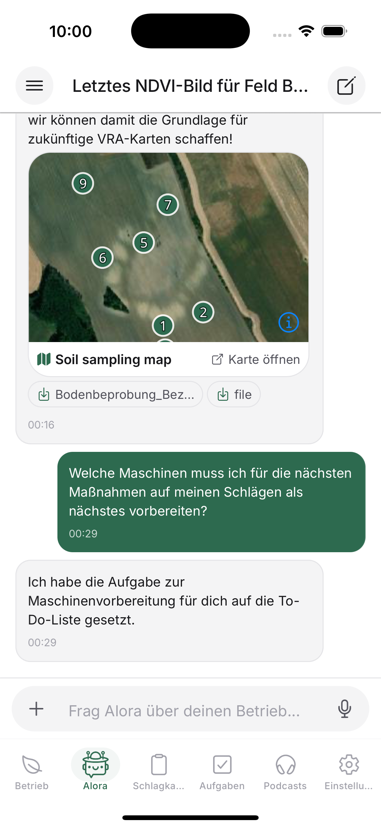
LangGraph orchestration
A stateful agent graph with specialist sub-agents for agronomy, assessments, documentation, and research.
Model-flexible
Developed vendor-independent and switched to different AI providers as needed. Not tied to any single one.
Multimodal
Photograph a pest or symptom for diagnosis, or speak instead of type. Vision and voice are first-class.
Multilingual
Answers in the user's own language, with localized crop and agronomy vocabulary.
Memory and audit
Long-term user memory and conversation summaries, plus full tool and model audit logs.
Works in the background
Heavy requests run on a Celery and Redis pipeline and finish even when the app is closed.
Integrates with any system and any data
API-first by design. Bring your identities, your fields, and your data formats. Xsupra maps onto them.
API-first gateways
A REST gateway with 160+ AI routes and a separate execution service, both with JWT and API-key auth and role-based access.
Your IDs, not ours
Every user, field, and company carries an external ID, so your systems stay the source of truth and map cleanly onto Xsupra.
Standard formats
GeoJSON, GeoTIFF, shapefiles, and ISO 11783-10 ISOXML for terminals, plus JSON, CSV, and PDF in and out.
Bring your data
Ingest field geometries, soil labs, yield, and documents from PostgreSQL, file upload, and registries like EPPO and BVL.
Teach it your agronomy
The rule-generation pipeline turns any document or URL into validated agronomic rules, reviewed before they go live.
Lifecycle hooks
Authenticated hook endpoints keep Xsupra in sync as fields are created, changed, or removed in your core system.
The moat is the integration
Each piece exists somewhere. Few have wired them together and shipped.
Agronomy plus AI
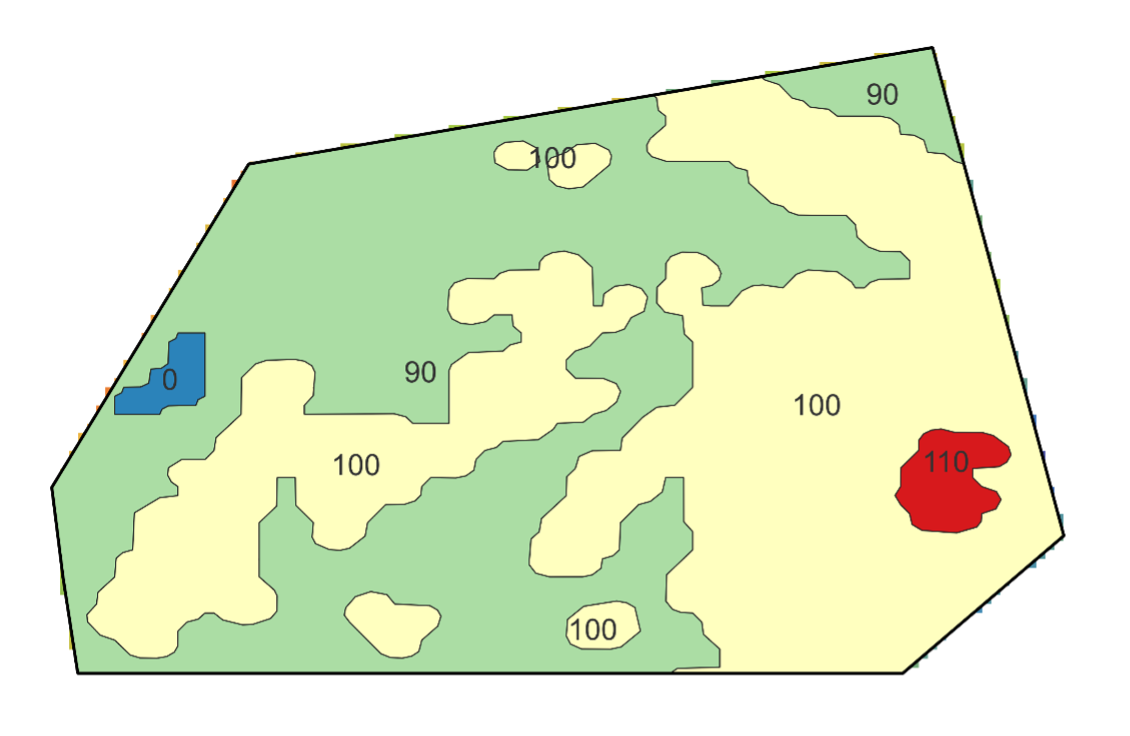
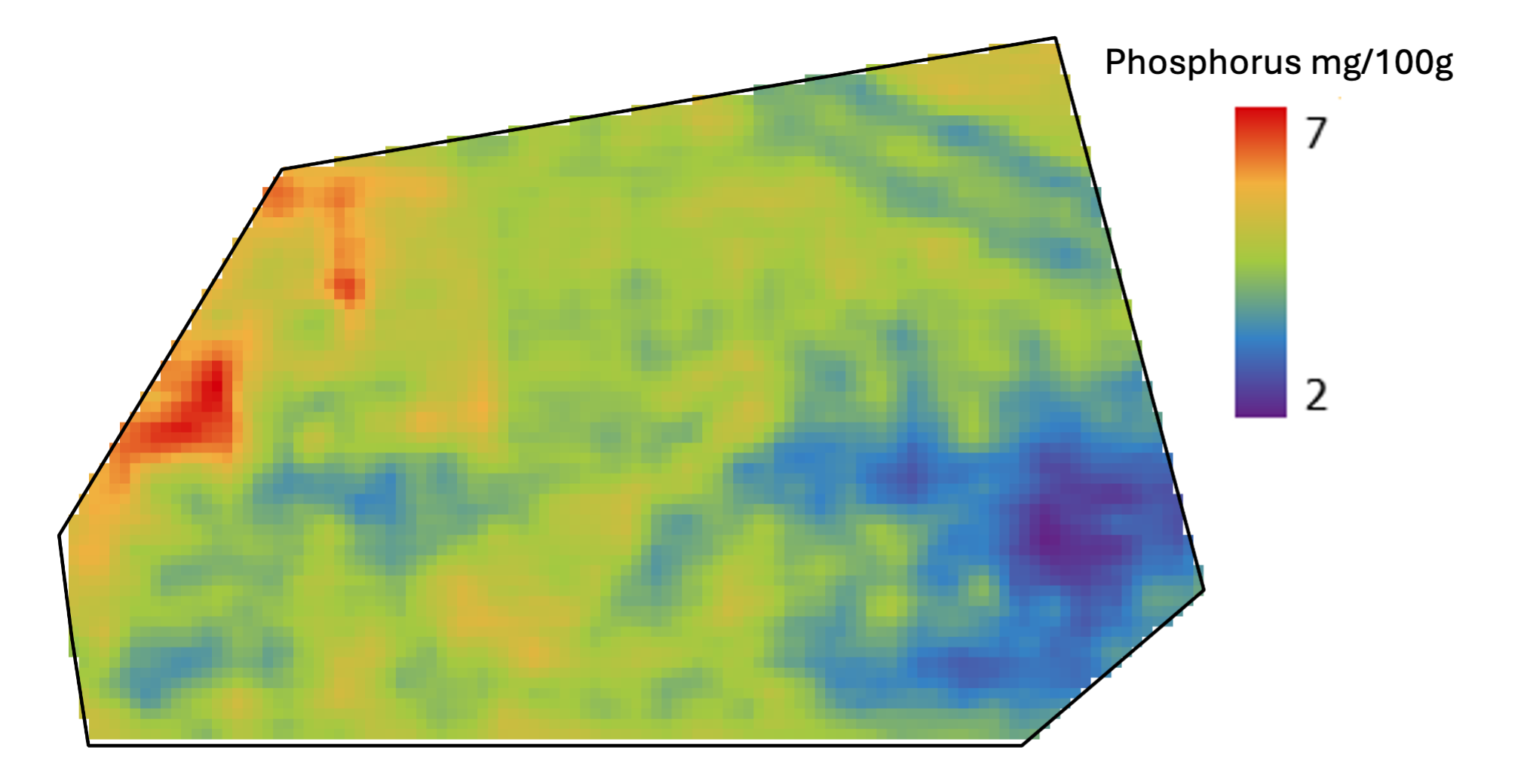
1,000+ curated rules and a geospatial machine-learning pipeline feed the agent, so answers are grounded, not generic.
Data plus action
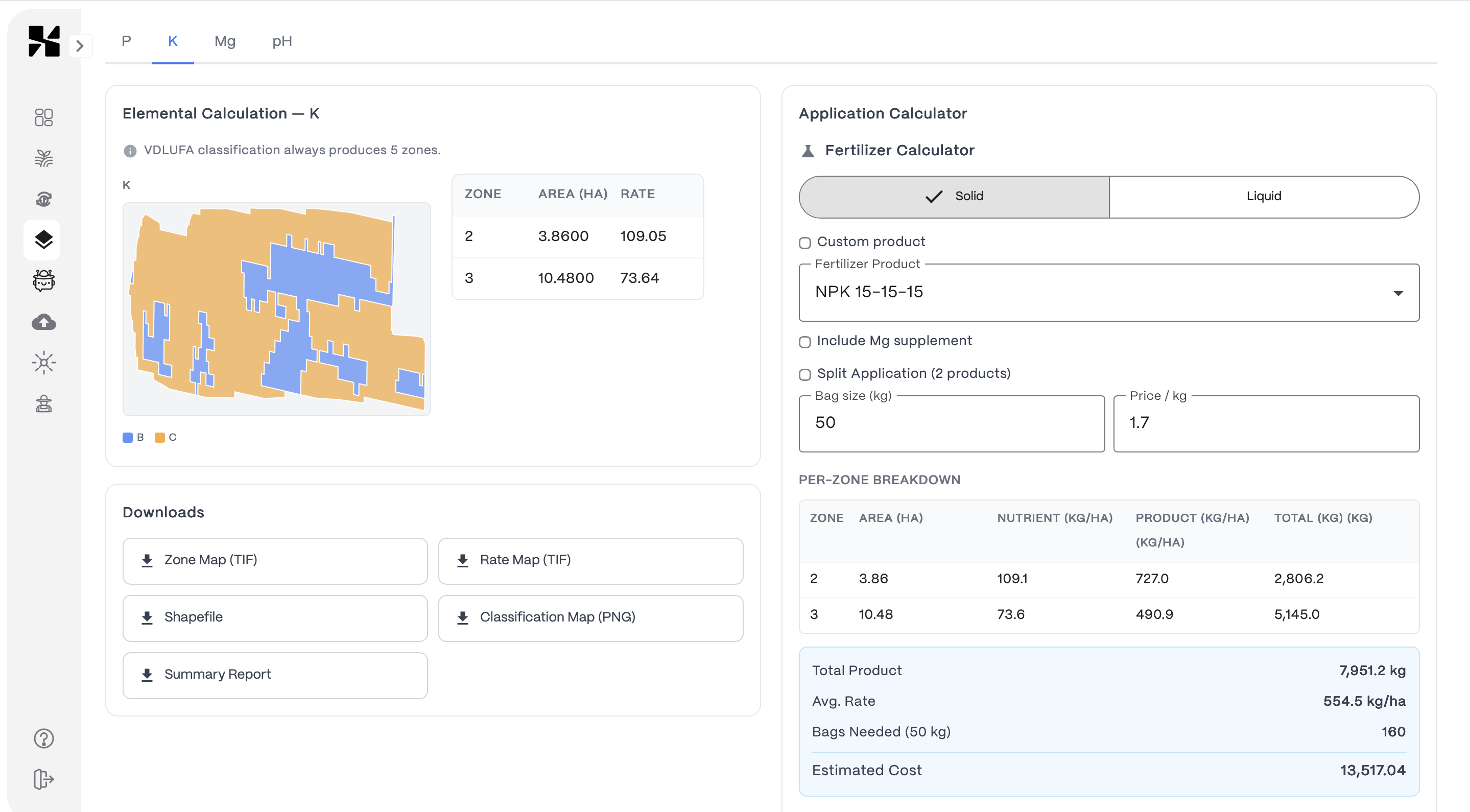
The same platform senses the field and writes back maps, documents, and tasks. Insight and execution in one loop.
Built for the EU
German DüV and GLÖZ compliance, BVL plant-protection lookups, and 19 languages out of the box.
Built for partnership
Whether you want to integrate, embed, or acquire, start with a conversation and a look at the data room.